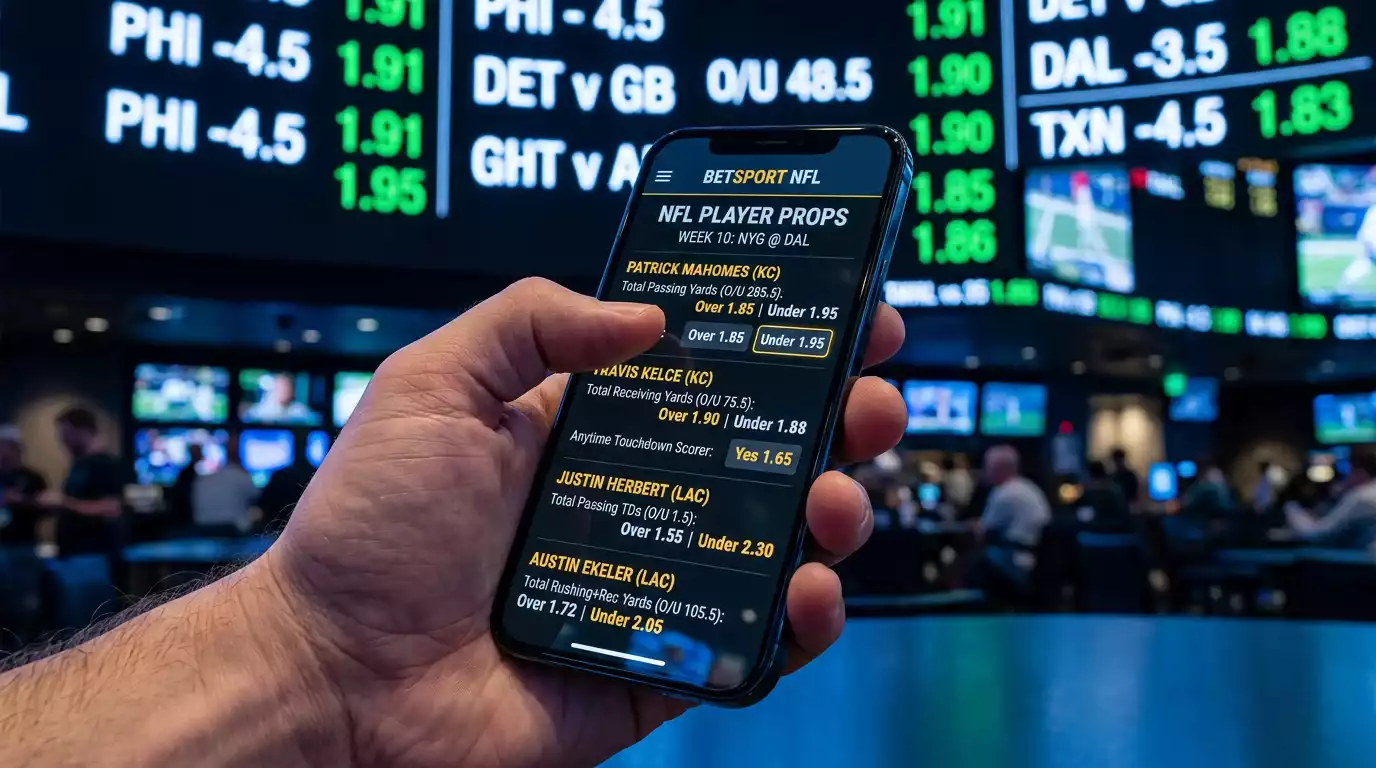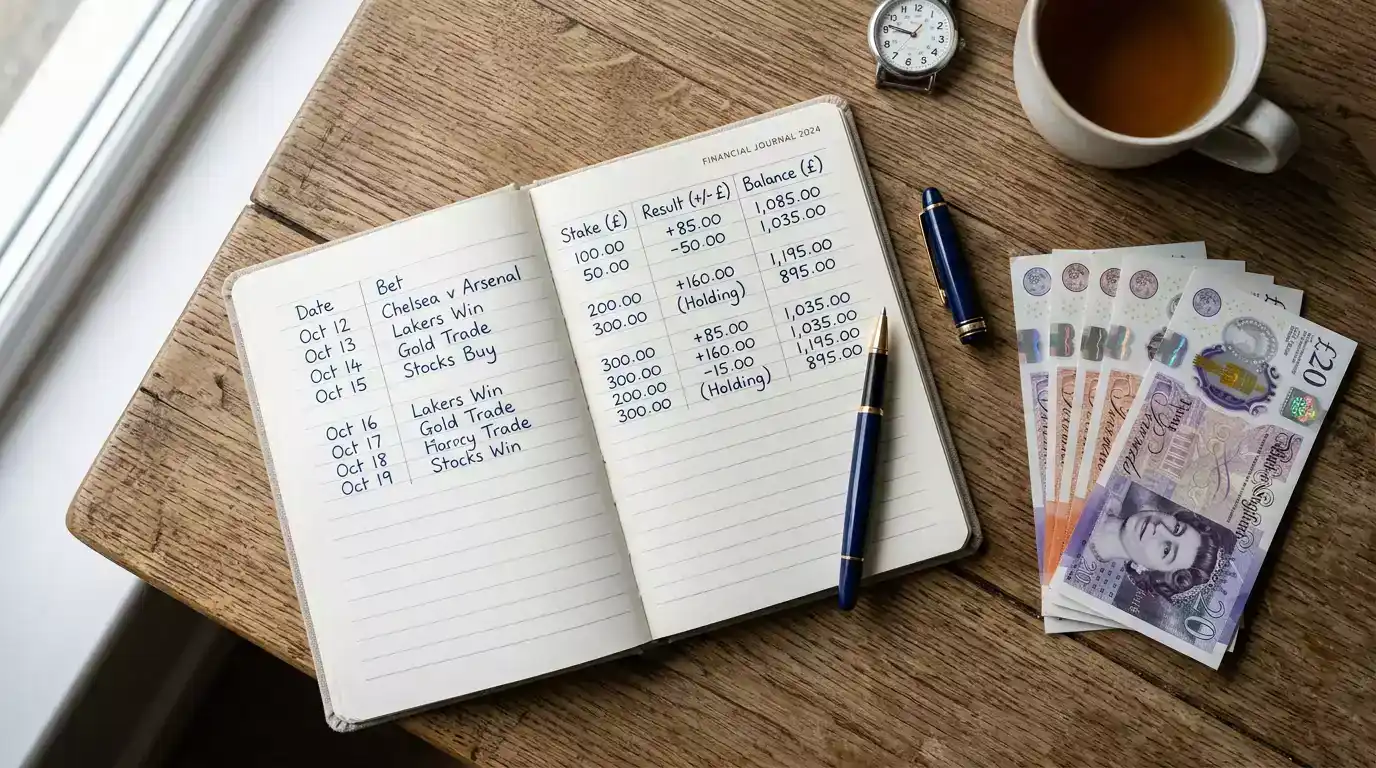
NFL Player Props
NFL Player Prop Bets for UK Punters
 Available in US
Data-driven NFL prop picks for UK bettors
Nine years ago, when I started modelling NFL player prop markets, the UK barely registered on the American football betting radar. That has changed dramatically. The UK now counts roughly 14.3 million NFL fans, nearly one in five British adults according to NFL Research, and prop betting has become the sharpest growth segment in the sport’s wagering ecosystem. During Super Bowl LX, player props accounted for up to 60% of all betting activity on some platforms, per Sportsepreneur data. That is not a niche any more. That is the main event.
Yet almost every resource ranking in search results right now is built for an American audience. The odds formats default to American moneyline. The sportsbook recommendations point to operators with no UK licence. The regulatory context is non-existent. And the mathematics behind what you actually pay (the hold percentage, the compounding vig on same-game parlays, the correlation tax nobody explains) gets brushed aside in favour of “hot picks” that expire by Sunday night.
This guide takes a different approach. I have written it specifically for UK bettors who want to understand the structure of NFL player prop markets, not just consume weekly tips. You will find every odds example presented in both decimal and fractional notation. Every strategic framework accounts for the UK regulatory landscape, from affordability checks introduced in 2025 to the remote betting tax arriving in 2027. And every claim about edges, hold percentages, and market mechanics is backed by data I can source, not by gut feeling dressed up as analysis.
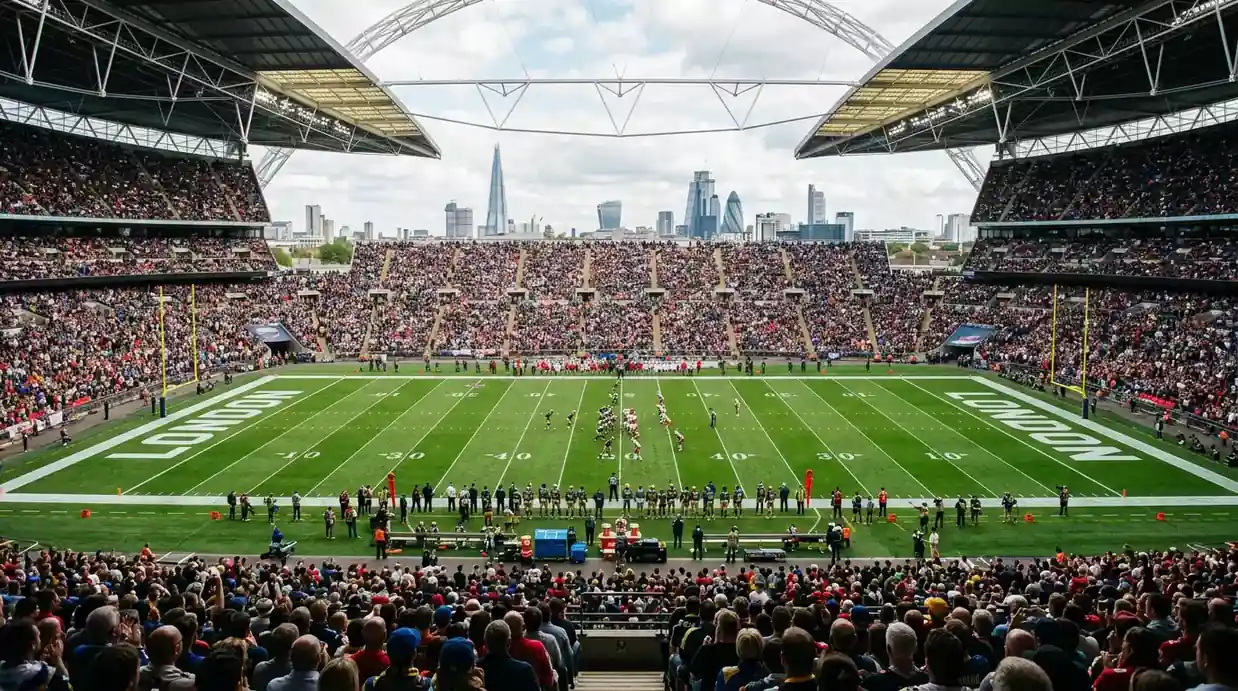
Whether you placed your first NFL prop bet last Thursday or you have been grinding receiving yards overs since the London games started at Wembley, this is the reference I wish had existed when I began. The prop market rewards preparation and punishes impulse. My job here is to make sure you are on the right side of that equation.
- Data-Driven Strategies for NFL Prop Betting Markets
- How NFL Player Prop Bets Work
- Reading Prop Odds in Decimal and Fractional Formats
- Types of NFL Player Prop Bets Worth Knowing
- Why Matchup Analysis Matters for Player Props
- Core Strategies for Finding the Best Player Props
- Same-Game Parlays and Player Props: The Hidden Cost
- Bankroll Management for NFL Prop Bettors
- UK Gambling Regulation and NFL Prop Betting
- Responsible Gambling Tools Every Prop Bettor Should Use
- Frequently Asked Questions About NFL Player Prop Bets
Data-Driven Strategies for NFL Prop Betting Markets
- NFL player props accounted for up to 60% of all Super Bowl LX betting activity, making it the dominant wagering market, not a niche.
- Single prop bets carry a 4-6% house edge, but same-game parlays compound that to 20-30%, generating the majority of sportsbook revenue from a minority of wagers.
- Unders on player props have historically hit at roughly 60% across multiple NFL seasons due to public bias toward overs.
- UK regulatory changes in 2025-2026, including financial vulnerability checks and a 25% remote betting tax from 2027, will directly affect prop pricing and account management.
- Every odds example in this guide uses UK-friendly formats (decimal and fractional), every strategy accounts for the UK regulatory landscape, and every statistical claim is sourced.
How NFL Player Prop Bets Work
The first prop bet I ever placed was a passing yards over on a Thursday night game. I had no idea what I was doing. I just liked the quarterback. That bet lost by three yards, and the sting of it taught me more about how props are structured than any tutorial could. So let me save you the tuition fee.
Player prop bet – a wager on an individual player’s statistical performance in a single game, independent of the match result. You are not betting on who wins. You are betting on what a specific player does: how many yards he throws, how many receptions she catches, whether he scores a touchdown.
The most common format is the over/under. A sportsbook sets a line, say 249.5 passing yards for a quarterback, and you decide whether the actual number will land over or under that threshold. The half-point eliminates the possibility of a push (a tie with the line), which means every bet resolves as a win or a loss. Clean, binary, no ambiguity.
Over/under (O/U) – a two-sided market where the bettor predicts whether a player’s stat total will exceed or fall short of the sportsbook’s posted line.
Proposition bet – the formal name for any wager that does not directly relate to the final outcome of a game. Player props are the largest subcategory.
Beyond over/unders, prop markets include anytime touchdown scorer bets (does the player score at any point in the game?), first touchdown scorer (higher odds, higher variance), and binary yes/no markets on events like “Will the quarterback throw an interception?” The anytime touchdown scorer market is the single most popular player prop by handle, according to BetMGM and ESPN data, followed by receiving yards over/under and first touchdown scorer.
What makes props different from spread or totals betting is granularity. A spread bet asks you to evaluate an entire team against another. A prop bet asks you to isolate one player’s output against a specific defence, in specific conditions, under a specific game script. That granularity is where edges live, but it is also where sportsbooks build wider margins, because fewer bettors do the work to price these markets accurately.
In the UK, 95% of all bets are placed online, per a Washington Post analysis of British gambling data. That means you have access to hundreds of player prop markets per NFL game, directly from your phone, across multiple licensed operators. The breadth of choice is a genuine advantage if you know what you are looking at. The rest of this guide is about making sure you do.
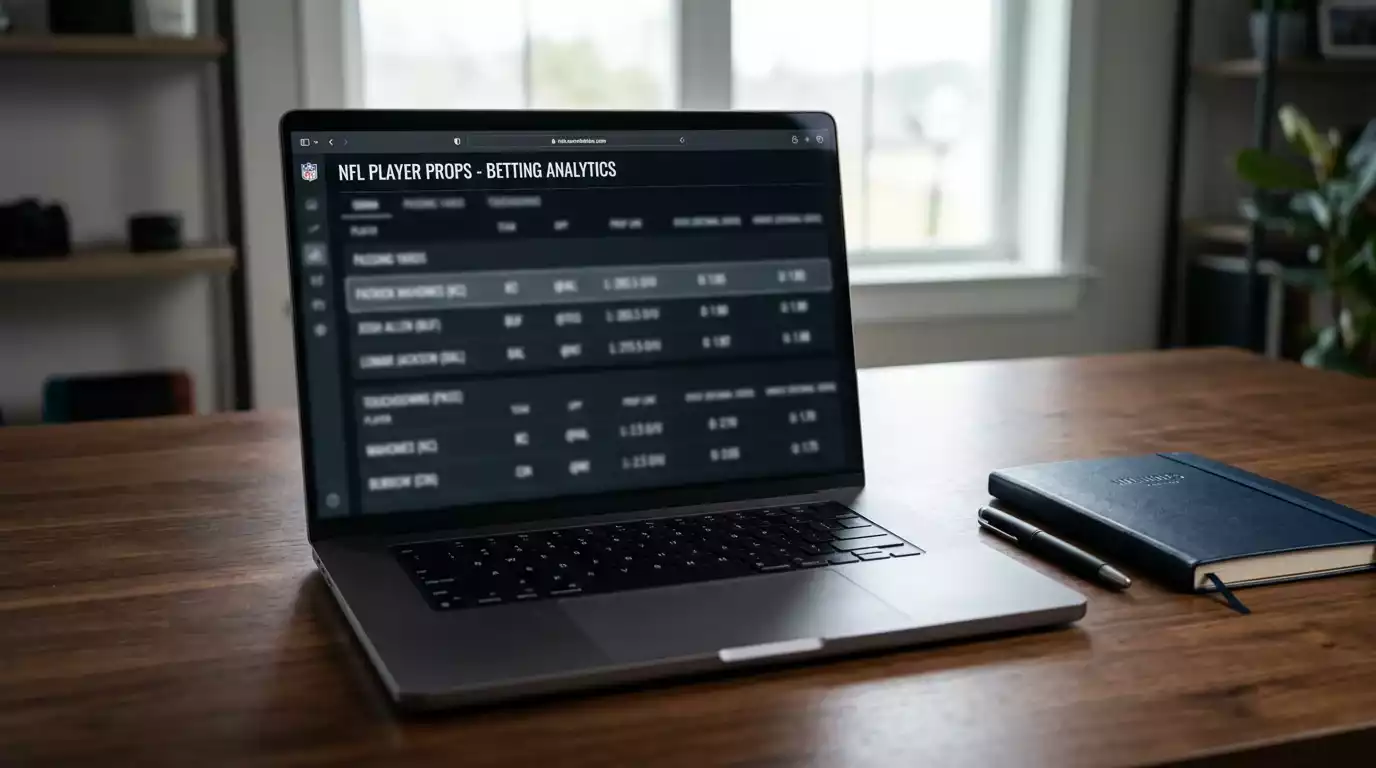
Example: Patrick Mahomes passing yards
Line: 274.5 yards
Over 274.5: American -110 | Decimal 1.91 | Fractional 10/11
Under 274.5: American -110 | Decimal 1.91 | Fractional 10/11
A £10 bet on the over at decimal 1.91 returns £19.10 if Mahomes throws 275 or more yards.
Reading Prop Odds in Decimal and Fractional Formats
Here is something that still surprises me: roughly 10% of the UK population bets on sports online, per the Gambling Commission, yet almost no NFL prop resource on the internet explains odds in the formats British bettors actually use. Every guide defaults to American moneyline – that -110 and +120 notation that means nothing unless you grew up with it. I am going to fix that right now.
UK sportsbooks typically display odds in either decimal or fractional format. Most platforms let you toggle between them, but decimal has become the default for online betting because the maths is simpler. If you understand one format well, you can evaluate any prop line in seconds.
The same prop in three formats
Rushing yards over 64.5:
American: -115 | Decimal: 1.87 | Fractional: 20/23
American: +100 | Decimal: 2.00 | Fractional: 1/1 (evens)
American: +150 | Decimal: 2.50 | Fractional: 3/2
Decimal odds tell you exactly what you get back per pound staked, including your original stake. A line of 1.87 means a £10 bet returns £18.70 total: your £10 stake plus £8.70 profit. To convert American odds to decimal: for negative American odds, divide 100 by the absolute value and add 1. So -115 becomes (100 / 115) + 1 = 1.87. For positive American odds, divide the odds by 100 and add 1. So +150 becomes (150 / 100) + 1 = 2.50.
Fractional odds show net profit relative to stake. At 3/2, you profit 3 for every 2 staked. To convert decimal to fractional: subtract 1, then express as a fraction. Decimal 2.50 becomes 1.50, which is 3/2. Decimal 1.87 becomes 0.87, or roughly 20/23. Fractional odds are deeply familiar to anyone who grew up betting on horse racing in the UK, but they can be awkward for prop comparison because the fractions get messy at tight margins.
Calculating implied probability from decimal odds
Implied probability = 1 / decimal odds x 100
If a prop line is priced at 1.91 decimal:
1 / 1.91 = 0.5236 = 52.36% implied probability
The other side (also 1.91): 52.36%
Combined: 52.36% + 52.36% = 104.72%
The 4.72% above 100% is the overround, the sportsbook’s built-in margin. On this line, the vig is roughly 2.3% per side.
That overround calculation is the single most useful skill I can give you. When you see a prop market where both sides are priced at 1.91, the combined implied probability exceeds 100% by about 4.7%. That excess is what you pay to play. On a standard spread bet, the overround is similar, typically 4-6% on single bets, per industry data. But the overround on props can be wider, especially on less liquid markets like individual sack totals or interception overs, where the sportsbook faces less sharp action and can build in more margin.
My advice: set your sportsbook display to decimal, keep a mental model of implied probability, and always calculate the overround before you decide a prop offers value. If you are used to fractional odds from horse racing, the switch takes about a week to feel natural. The clarity it gives you is permanent. For a deeper breakdown of how to compare prop lines across platforms and spot pricing inefficiencies, I have written a dedicated guide on NFL player prop odds that walks through the full process.
Types of NFL Player Prop Bets Worth Knowing
I once watched a bettor scroll past 200 prop markets for a single NFL game and place a wager on the very first one he recognised. That is the equivalent of walking into a restaurant, ignoring the menu, and ordering whatever the person next to you is eating. The prop board is enormous, and not every market deserves your money.
What follows is a map of the major prop categories, ranked roughly by popularity and liquidity. The anytime touchdown scorer market leads all player props by handle, per BetMGM and ESPN reporting, followed by receiving yards over/under and first touchdown scorer. Liquidity matters because it affects the width of the margin: the more money a market attracts, the tighter the sportsbook prices it, and the less you pay in vig.
Passing Yards O/U
The flagship quarterback prop. Line typically set between 220 and 310 yards depending on the quarterback tier and matchup. High liquidity, tight margins. Heavily influenced by game script: a team trailing early throws more.
Rushing Yards O/U
Running back territory, though mobile quarterbacks have carved out their own sub-market. Lines range from 40 to 100+ yards. More volatile than passing yards because a single breakaway run can swing the result.
Receiving Yards O/U
Set for wide receivers and tight ends. Target share is the leading indicator here. A receiver who sees 25% of his team’s targets has a fundamentally different prop profile than one at 12%.
Anytime Touchdown Scorer
The most popular individual prop market. Simple mechanics: the player scores a touchdown at any point, you win. Red zone usage and goal-line carries are the key drivers. For a deep dive into strategy and odds, see the full guide to anytime touchdown scorer bets.
Completions O/U
A volume metric for quarterbacks. Predictable and relatively low-variance compared to yards, because completion counts track attempt volume closely. Underrated by casual bettors.
Interceptions O/U
High-variance, situation-dependent. Trailing teams throw more aggressively, inflating interception risk. A niche market with wider margins.
Sack Totals
Team or individual sack props. Pass rush rate and offensive line quality are the core inputs. Thin liquidity on individual player sack props means wider vig.
Highest liquidity
Passing yards, anytime TD scorer, receiving yards – tightest margins, most sharp action
Moderate liquidity
Rushing yards, completions, first TD scorer – decent pricing, some edge potential
Lowest liquidity
Interceptions, individual sacks, receptions – wider margins, higher variance, sharper edges for those who do the work
The pattern is straightforward: the more popular the market, the tighter the line, the harder it is to find an edge. But you also pay less in margin. Niche markets like sack props and interception overs offer wider inefficiencies, but the vig punishes you if your analysis is not sharp. My approach has always been to concentrate on mid-liquidity markets (rushing yards, completions, first TD) where the pricing is fair enough to survive long-term but the public attention is low enough to leave value on the table.
Each position demands its own analytical framework. Quarterback props hinge on matchup and game script; I cover this in detail in the quarterback prop bets guide. Running back props are driven by workload share and defensive rush rankings. Wide receiver and tight end props depend on target share and coverage matchups. The card-grid above is your starting map. The position-specific guides are your turn-by-turn directions.
Why Matchup Analysis Matters for Player Props
A few seasons back, I bet the over on a receiver’s yards against a defence ranked 28th against the pass. He caught two balls for 19 yards. The defence had switched to a zone-heavy scheme two weeks earlier and nobody, including me, had updated their model. That was the week I stopped using season-long averages as my primary input and started building matchup profiles from recent data.
Historical averages lie. They flatten two months of production into a single number that tells you what a player did, not what he is likely to do next Sunday against a specific opponent. Matchup analysis replaces that backward-looking average with a forward-looking projection built on the actual conditions of the game.
Five factors to check before placing any player prop
- Defensive ranking against the position – pass defence DVOA, rush yards allowed per game, blitz rate. Not just overall rank, but positional specificity.
- Injury report – a missing cornerback upgrades every receiver on the opposing team. A backup centre increases sack probability. Injuries ripple.
- Weather – wind above 15 mph suppresses passing volume. Rain shifts production to the ground game. Indoor stadiums remove this variable entirely.
- Game script – implied team totals tell you whether a team is expected to lead or trail. Trailing teams throw more, inflating passing and receiving props. Leading teams run more, boosting rushing props.
- Pace of play – a team that runs 70 plays per game gives its players more opportunities than one running 58. More plays mean more volume, which pushes props upward before any matchup analysis even enters the picture.
Implied team total – the number of points a team is expected to score in a game, derived from the game total and point spread. If the total is 48.5 and one team is favoured by 3.5, the favourite’s implied total is (48.5 + 3.5) / 2 = 26.0 points. A higher implied total signals more offensive opportunities – and higher prop ceilings.
One pattern I have observed consistently across my years of tracking: unders on NFL player props have hit at roughly a 60% rate across multiple seasons, per CBS Sports analysis. The reason is structural. The betting public gravitates toward overs because it is more exciting to root for a player to exceed a number than to fall short. Sportsbooks know this, shade lines slightly higher than their true projection to exploit the imbalance, and the result is a persistent under-bet advantage for those willing to take the less glamorous side.
Dr. Joshua Grubbs, a clinical psychologist at the University of New Mexico who studies gambling behaviour, frames the broader dynamic well: “Sports gambling itself is not inherently risky but sports gamblers are!” That tension between the market structure and the bettor’s own impulses is exactly what matchup analysis is designed to manage. You are not gambling on a hunch. You are building a case from data, testing it against the line, and deciding whether the price is right.
The checklist above is your minimum viable process. If you are not checking all five factors before every prop bet, you are leaving information on the table. In a market where the sportsbook’s edge compounds over time, leaving information on the table means leaving money on the table.
Knowing which factors matter is half the battle. The other half is having a systematic process that prevents you from skipping steps when the Thursday night kick-off is 20 minutes away and you have not checked the injury report yet.
Core Strategies for Finding the Best Player Props
Sportsbooks are not charities. The average hold percentage across US sportsbooks has climbed from 6.7% in 2018 to above 9% by 2024-2025, per Doc’s Sports industry data, and UK operators face similar dynamics. That number is the price of admission: the percentage of every pound wagered that the house expects to keep over time. Your job, if you want to survive in this market, is to find spots where your analysis gives you an edge that exceeds that cost.
I am going to outline the core strategies here in overview. Each one deserves, and has, its own detailed breakdown, which I have written as a comprehensive NFL prop betting strategy guide. What follows is the framework; the strategy guide is where you build the muscle.
Do
- Line shop across multiple UK sportsbooks before committing. A difference of 0.5 points on a passing yards line translates to measurable expected value over a season.
- Check the injury report twice: once at the Wednesday initial report, once at the Friday final designation. Key absences create value across the entire opposing roster.
- Target unders on popular player props. The public overweights overs, and sportsbooks shade accordingly.
- Calculate implied probability before placing any bet. If you cannot articulate why the true probability exceeds what the odds imply, you do not have an edge.
Don’t
- Chase steam moves – when a line shifts rapidly after sharp money arrives, the value has already been captured. You are buying at retail after the sale ended.
- Ignore the vig on parlays. Single bets carry a 4-6% hold, per BettorEdge data, but parlay hold stretches to 20-30%. Every additional leg compounds the cost.
- Follow public betting percentages blindly. “80% of bets are on the over” does not mean the over is correct – it often means the line has been shaded to exploit that consensus.
- Anchor to a player’s last game. One performance is noise, not signal. Use rolling multi-week samples weighted toward recent matchups.
The under-bet advantage deserves special emphasis. The structural reason it persists is demand asymmetry: casual bettors find it more exciting to cheer for a player to break through a number than to fall short. Sportsbooks exploit that preference by shading lines slightly above their true median projection, which creates a persistent edge for the bettor willing to take the less glamorous side. Not blindly. Only when the matchup data, game script, and defensive metrics support it. But when they do, you are swimming with the current rather than against it.
Matthew Davidow, a former executive at Huddle, which supplied odds technology to major sportsbooks, was blunt about the state of the market: “The current situation is terrible for society. My issue isn’t that people are allowed to bet. It’s that the odds are terrible, so people’s chance to lose is way higher than it should be.” That candour from someone inside the industry should tell you everything about why strategy, not volume or luck or gut feeling, is the only sustainable edge.
The best prop bettors are not the ones who pick the most winners. They are the ones who consistently find prices that undervalue their assessed probability – and size their bets accordingly. Value over volume, always.
Line shopping, implied probability, under-bet bias, injury-driven value, game script alignment – these are the pillars. The strategy guide expands each one into a step-by-step workflow with worked calculations. But if you take nothing else from this section, take this: the market is priced to extract money from impulsive bettors. Every strategy above is designed to make you the opposite of impulsive.
Same-Game Parlays and Player Props: The Hidden Cost
If there is one product the gambling industry desperately wants you to use, it is the same-game parlay. During Super Bowl LX, SGPs made up more than 25% of the total handle, per Sportsepreneur analysis. Jason Robins, the CEO of DraftKings, told a Goldman Sachs conference that parlay mix goes up every quarter, and his tone was not cautious. It was celebratory. That should give you pause.
UK bettors are already familiar with the accumulator, the traditional multi-leg bet that combines selections from different games. Same-game parlays are a variation where all legs come from a single match: the quarterback throws for over 275 yards, the running back scores a touchdown, the receiver catches five or more passes. The appeal is obvious. The maths behind the pricing is less so.
Type in the price of each leg and the combined price your bookmaker is offering. This works out what the parlay should pay, what you are actually being paid, and how much of every pound the shortfall quietly takes.
How it works. Each leg price is stripped of its market margin to get a true probability, those probabilities are multiplied, then lifted for however related you have said the legs are, because linked outcomes land together more often than chance allows. That gives the price a parlay would pay if nobody took a cut. The gap between it and the number on your bet slip is the hold. More in the guides to same-game parlays and reading prop odds.
Estimates only. Bookmakers price correlation with their own models and will not publish them. 18+ — please gamble responsibly. Free, confidential support at BeGambleAware.
Compounding vig on a three-leg SGP
Assume each leg is a standard -110 (decimal 1.91) prop. On a single bet, the hold is roughly 4.5%.
Leg 1 true probability: 50%. Priced at 52.4% implied (1.91 decimal). Vig: 2.4% per side.
Multiply three legs: if the sportsbook priced each leg independently, the combined decimal odds would be 1.91 x 1.91 x 1.91 = 6.97.
But the actual SGP payout offered is typically around 5.50-6.00, a significant discount from 6.97.
That gap between the "fair" combined odds and the actual SGP price is the compounding vig plus the correlation adjustment. On a three-leg SGP, total hold often reaches 15-20%, compared to 4-6% on a single prop.
In New Jersey, parlays represented 27% of all wagers but generated 72.5% of sportsbook revenue, per covers.com data. In Maryland, the split was 36% of handle producing 63% of revenue, per Legal Sports Report. The house does not promote parlays because they are good for you.
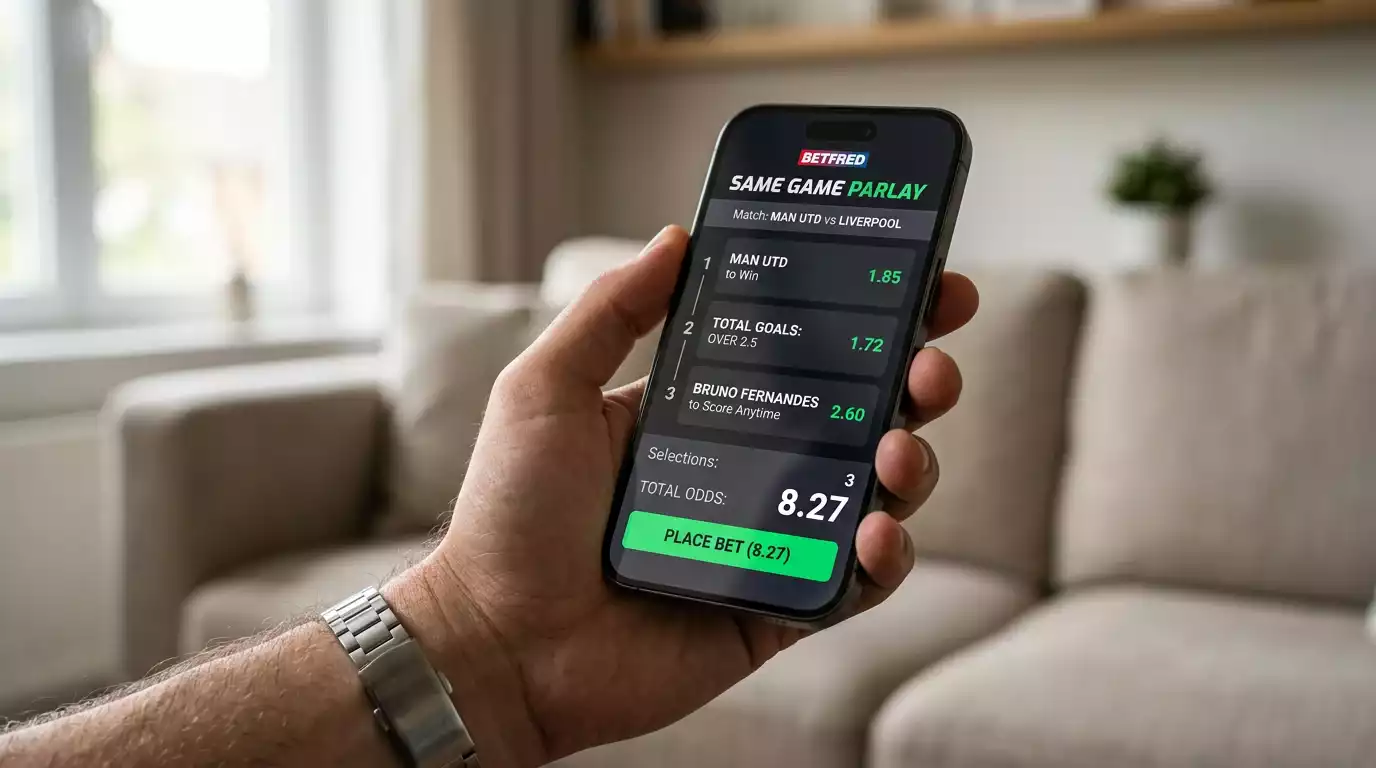
The correlation tax – When you combine a quarterback's passing yards over with his top receiver's receiving yards over, those outcomes are positively correlated: if the quarterback throws a lot, the receiver probably catches a lot. The sportsbook knows this, and instead of giving you the full combined odds of two independent events, it discounts the payout to account for the dependency. You pay extra precisely because your "smart" combination makes logical sense. The more intuitive your SGP feels, the more you are likely paying in correlation penalty.
Nik Bonaddio, former Head of Product at FanDuel, estimated that perhaps 5% of bettors genuinely understand the house edge on parlays. The other 95% see a potential payout of 15-to-1 and imagine the upside without calculating the true cost of getting there. Every promotional boost, every "build your own bet" prompt, every in-app nudge that encourages you to add another leg to your SGP is a revenue optimisation tool, not a favour.
None of this means you should never touch an SGP. But the conditions under which one makes mathematical sense are extraordinarily narrow: every leg must carry individual positive expected value, and the legs should ideally be uncorrelated or negatively correlated. In practice, that combination is rare. The full breakdown of when SGPs make sense, and why they almost never do, lives in my same-game parlay NFL guide, which walks through the maths leg by leg.
For now, the takeaway fits in one sentence: if a sportsbook is promoting it aggressively, the maths probably favours the sportsbook.
Bankroll Management for NFL Prop Bettors
There are 290 million online bets placed every month in the UK, per Statista data. Most of those bettors have no bankroll management system. They deposit, bet until the balance hits zero, deposit again, and tell themselves the next deposit is "starting fresh." I know because I did exactly this for my first two seasons before I started tracking every wager properly.
Player props carry higher variance than spread betting. A spread resolves around a median outcome shaped by the full game: dozens of plays, multiple possessions, regression toward the mean. A prop resolves around a single player's output, which can swing on one broken tackle, one weather-delayed drive, one early injury. That volatility demands a more disciplined approach to staking.
Unit sizing: the 1-3% rule
Define your bankroll: the total amount you have allocated specifically for prop betting this season. Not your savings. Not your rent. A separate, dedicated sum.
One unit = 1% of that bankroll. If your bankroll is £1,000, one unit is £10.
Standard prop bet: 1 unit. High-confidence bet with a clear edge: 2 units. Maximum, regardless of confidence: 3 units.
At 1% per bet, you can absorb a 10-bet losing streak and still have 90% of your bankroll intact. At 5% per bet, a common amateur mistake, the same losing streak leaves you at 50%. Variance does not care about your confidence level.
Do
- Use flat staking – the same unit size on every bet, regardless of how "certain" you feel. Consistency removes emotion from the equation.
- Set session limits: a maximum number of prop bets per week (I use 10-15) and a maximum loss limit per session.
- Review your bankroll monthly. If you have lost 20% or more, scale down your unit size to reflect the new reality.
Don't
- Chase losses by increasing stakes after a bad week. Dr. Joshua Grubbs, a clinical psychologist who researches gambling behaviour, identifies loss chasing as the single most diagnostic marker of problematic gambling: "The difference between someone who gambles for fun and someone with a gambling problem is something we can usually get at with just one question: Do you chase your losses and try to win back what you lost?"
- Increase unit size after winning streaks. Positive variance is not a signal that your edge has grown – it is just variance.
- Treat prop betting money as fungible with other spending. The moment you are betting with money earmarked for bills, the game has changed from entertainment to risk.
Bankroll management is not glamorous. It does not appear in highlight reels or tip sheets. But over the course of an 18-week NFL season with play-offs, it is the single largest determinant of whether you finish in profit or in a hole. The prop market does not reward the bettor who bets the most. It rewards the bettor who survives the longest with enough capital to exploit the edges that inevitably appear.
UK Gambling Regulation and NFL Prop Betting
Regulation is the part of the guide most bettors skip. I understand the impulse. Odds formats and matchup analysis feel actionable, while licensing frameworks feel bureaucratic. But the regulatory changes rolling through the UK right now will directly affect your ability to bet on NFL props, the prices you receive, and the tools you have to protect yourself. Ignoring this section is like ignoring the weather forecast before an outdoor game.
The UK gambling industry generated £16.8 billion in gross gambling yield for the year ending March 2025, a 7.3% increase year-on-year, per the Gambling Commission's annual report. That scale attracts scrutiny, and the Commission has responded with a series of reforms that hit online sports bettors hardest.
UKGC licensing – Every sportsbook operating in the UK must hold a licence from the Gambling Commission. If an operator is not licensed, it is not legal to bet with them from a UK address, regardless of how good their NFL prop markets look. Always verify licensing status before opening an account.
The most significant recent change for prop bettors is the financial vulnerability check, mandatory for online operators since 28 February 2025, per Clifford Chance analysis. If your betting patterns trigger specific thresholds (the exact triggers are not publicly disclosed, but they relate to deposit frequency, loss levels, and account behaviour) the operator is obligated to assess your financial circumstances. This can include requests for income documentation. It is not a punishment; it is a regulatory requirement designed to prevent harm. But it does mean that high-volume prop bettors should expect these checks and have documentation ready.
Affordability checks from 2025 – Online operators must now conduct financial vulnerability assessments. If you receive a request for income or affordability documentation from your sportsbook, this is a regulatory obligation, not a discretionary action by the operator. Cooperating promptly keeps your account functional.
Also from 2025: granular marketing consent. Since 1 May 2025, operators must obtain separate consent for each marketing product and channel, per ICLG reporting. You can opt into email promotions for sports betting while opting out of casino offers, or vice versa. This gives you more control over the promotional noise that often encourages impulsive prop betting.
The stake limits introduced on 9 April 2025 (£5 per spin for online slots for adults aged 25 and older, dropping to £2 for those aged 18-24 from 21 May 2025) do not directly apply to sports betting. But they signal the regulatory direction: lower limits, tighter oversight, more consumer protection. Sports betting-specific stake limits remain a possibility in future legislation.
Looking ahead, the biggest structural change is the remote betting rate of 25% that takes effect on 1 April 2027, per the Finance Act 2026 as analysed by the House of Commons Library. The Treasury estimates this will generate £810 million in 2026/27, rising to £1.16 billion by 2030/31. Sportsbooks will face a choice: absorb the tax hit, reduce their own margins, or pass the cost to bettors through tighter odds. History suggests the cost flows downstream. UK prop bettors should expect marginally worse pricing on NFL markets once the new rate takes hold. That is another reason to master line shopping and value identification now, while the pricing environment is still relatively favourable.
Responsible Gambling Tools Every Prop Bettor Should Use
Dr. Joshua Grubbs, whose research at the University of New Mexico focuses on gambling psychology, does not mince words about where prop bets sit on the risk spectrum: "I don't think that prop bets and in-play betting should be allowed at all. I understand that's often the most exciting and fun bet for some people. It's also got the highest risk. We don't sell 200-proof pure ethanol to people so they can get drunk faster." You do not have to agree with his policy prescription to take his clinical observation seriously. Prop bets are fast, granular, and personal: qualities that make them engaging for informed bettors and dangerous for impulsive ones.
Grubbs has also argued for structural protections: "Having limits on prohibiting prop bets, prohibiting in-play betting is always wise because it does reduce the risk of people becoming extremely impulsive." Whether or not regulators adopt those recommendations, the tools already available on UK platforms can do much of the same work, if you actually use them.
If you or someone you know is experiencing gambling-related harm, contact GamCare (0808 8020 133, free and confidential) or visit the BeGambleAware website for information and support. The National Gambling Helpline is available 24 hours a day, 7 days a week.
Responsible gambling tools available on UK-licensed sportsbooks
- Deposit limits – set daily, weekly, or monthly caps on how much you can deposit. Once hit, you cannot add more funds until the period resets. Set these at account creation, before the first bet.
- Reality checks – timed notifications that alert you after a set period of continuous betting. Most platforms allow you to set these at 30-minute, 1-hour, or 2-hour intervals.
- Loss limits – a separate cap on net losses per day, week, or month. Distinct from deposit limits because they track actual losses, not just deposits.
- Cooling-off periods – short-term breaks from your account, typically 24 hours to 6 weeks. Your account is locked for the duration, and you cannot reverse the decision mid-period.
- Self-exclusion (GAMSTOP) – the UK's national self-exclusion scheme for online gambling. Registering locks you out of all UKGC-licensed online gambling sites for a minimum of six months, up to five years. It is a serious step, designed for people who recognise they have lost control.
I set deposit limits on every sportsbook account I use. Not because I think I have a problem, but because I know that discipline at 2 AM after a bad Sunday slate is different from discipline at 10 AM on a Tuesday. The limits remove the decision from the moment when I am least equipped to make it well.
The same principle applies to session limits. NFL props are available from Thursday night through Monday night, a four-day window every week during the season. If you find yourself betting on every game across that window, you are almost certainly betting on games where you have no genuine edge. Setting a weekly bet limit of 10-15 props per week, which forces you to be selective, which is exactly where value comes from.
Responsible gambling is not an afterthought or a regulatory checkbox. It is the structural foundation that makes everything else in this guide sustainable. Without bankroll discipline and self-awareness, the best matchup analysis in the world just means you lose more efficiently.
Frequently Asked Questions About NFL Player Prop Bets
What is a player prop bet in the NFL?
A player prop bet is a wager on an individual player's statistical performance in a single NFL game, independent of the match outcome. Common examples include betting whether a quarterback will throw over or under 260.5 passing yards, or whether a running back will score a touchdown. The bet resolves based solely on that player's stats, not on which team wins. Prop markets cover passing, rushing, receiving, touchdowns, interceptions, sacks, and more – with the anytime touchdown scorer market consistently ranking as the most popular by total handle.
How do NFL player prop odds work in decimal and fractional formats?
Decimal odds show your total return per pound staked, including the stake itself. A prop priced at 1.91 decimal returns £19.10 on a £10 bet (£10 stake + £9.10 profit). Fractional odds show net profit relative to stake: 10/11 means you profit £10 for every £11 wagered. To calculate implied probability from decimal odds, divide 1 by the decimal price and multiply by 100. For example, 1 / 1.91 = 52.4% implied probability. The difference between the combined implied probabilities and 100% represents the sportsbook's margin (overround). Most UK sportsbooks allow you to toggle between decimal and fractional display in your account settings.
What factors should I consider when choosing NFL player props?
Five core factors: defensive ranking against the relevant position (pass defence metrics for quarterback props, rush defence for running back props), the injury report (both for the player's team and the opponent), weather conditions at outdoor venues, projected game script (whether a team is expected to trail or lead, based on implied team totals), and pace of play (total plays per game). Matchup-specific data consistently outperforms season-long averages as a predictive input, especially from mid-season onward when sample sizes stabilise.
Are same-game parlays with player props worth it?
Rarely, from a mathematical standpoint. Same-game parlays compound the sportsbook's margin on every leg. A single prop bet typically carries a 4-6% hold, but a three-leg SGP can reach 15-20% effective hold. Additionally, sportsbooks apply a correlation penalty when SGP legs are statistically related – such as a quarterback's passing yards and his receiver's receiving yards – reducing the payout below what independent odds would produce. SGPs are the fastest-growing revenue product for sportsbooks precisely because they generate significantly higher margins. An SGP only makes mathematical sense when every individual leg carries positive expected value and the legs are genuinely uncorrelated – a combination that is rare in practice.
What is the house edge on NFL player prop bets?
On a standard single prop bet, the house edge (hold percentage) typically runs between 4% and 6%, similar to spread betting. This is built into the odds as the overround – the amount by which combined implied probabilities exceed 100%. However, niche prop markets with lower liquidity (individual sack props, interception overs) often carry wider margins. The average hold percentage across US sportsbooks has risen from 6.7% in 2018 to above 9% by recent years, a trend driven partly by the growing share of parlays, which hold between 20% and 30%. In Nevada, sportsbooks have held nearly 31% on parlays over four decades of tracking.
How do I manage my bankroll when betting on NFL props?
Define a dedicated prop betting bankroll – money separate from living expenses. Set one unit at 1% of that bankroll, and stake 1-3 units per bet depending on your confidence level. Use flat staking (the same unit size on every bet) rather than scaling up after wins or losses. Set weekly bet limits (10-15 props per week is a reasonable ceiling) and monthly loss limits. Review your bankroll at the end of each month: if you have drawdown beyond 20%, reduce your unit size to match. The goal is survival through variance so you are still capitalised when genuine edges appear.
Is it legal to bet on NFL player props in the UK?
Yes, provided you use a sportsbook licensed by the UK Gambling Commission (UKGC). All licensed operators are legally permitted to offer NFL player prop markets to UK residents aged 18 and over. Recent regulatory changes include mandatory financial vulnerability checks for online operators (from February 2025), granular marketing consent requirements (from May 2025), and a forthcoming remote betting tax of 25% effective April 2027. These rules apply to all UKGC-licensed platforms and are designed to increase consumer protection. Always verify that your sportsbook holds a valid UKGC licence before opening an account or depositing funds.
Created by the ”nfl Best Player Prop Bets” editorial team.